
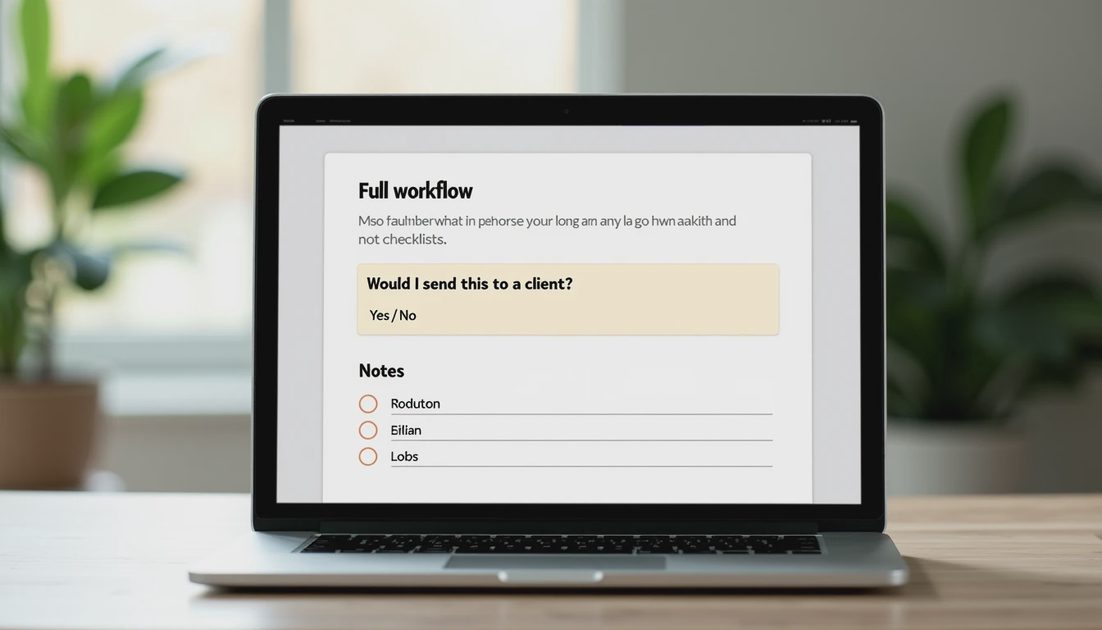
Every complete workflow test on this site ends with the same question: would I actually send this to a client under my name? That single filter has eliminated more impressive-looking outputs than any other criterion I use. It is the difference between a result that survives professional contact and a result that only looks good in isolation.
This is from a real, full workflow test standard. I am Lena Voss. In agency life the final deliverable was the only measure that ultimately mattered. I still use it for every AI-assisted piece of work that appears on Workflow Ink. Ran the full process myself. This is what the filter looks like in practice.
Why the Final Filter Matters
Demos and first outputs can look strong. Revision rounds can improve them. Consistency checks can catch drift. None of those stages answer the professional question: is this ready to represent the brand or the creator in front of a real audience or client?
I apply the filter at the end of every complete run. The answer is binary for publishing and recommendation decisions: yes or no. “Almost” is recorded as no until the remaining gaps are closed. This rule has kept me from recommending tools or workflows that produce attractive intermediate results and weak final ones.
Decision Framework Across Stages
Stage Completed | Still Apply Final Filter? | Common Outcome in Tests |
|---|---|---|
First generation | Yes | Usually no |
After revisions | Yes | Sometimes yes |
After consistency check | Yes | More often yes |
After human polish | Yes | Highest yes rate |
The framework keeps the standard consistent across writing, image, audio, and video tests.
What Usually Fails the Test
Across the tests I have run, the most common reasons a result fails the final filter are:
Residual generic language or visual clichés that would not survive a client review
Inconsistent character, voice, or style across a set that is supposed to feel coherent
Unresolved licensing or commercial-use questions that create professional risk
Time cost that exceeds the practical value of the result for the intended use
A persistent feeling that the work still needs “just one more pass” that never quite finishes
Any one of these is enough for a no. Multiple failures make the verdict automatic. I record the specific failure reason so the same pattern can be recognized faster next time.
What Passes
Work that passes has clear strategic alignment with the brief, recognizable voice or visual control, acceptable time cost relative to the value of the deliverable, and no open professional risks. It does not have to be perfect. It has to be something I would put my name on and hand to a client or publish under a creator’s identity without hesitation.
The pass rate is lower than the rate of “impressive first outputs.” That gap is the point of the filter.
Tested it properly. Here’s the real result: the final deliverable test is stricter than most demo standards and more useful for independent creators who cannot afford public mistakes or wasted cycles.
How This Standard Shapes the Site
Every post on Workflow Ink is written under this filter. Recommendations, process notes, failure reports, and stack decisions all pass through the same question. That is why the site stays practical rather than promotional. If I would not send the work, I do not recommend the workflow that produced it.
Future work will continue to document complete workflows and the moments when the final deliverable test is the only criterion that still matters. The question remains the same: would I actually send this to a client?
Additional Process Notes from the Test
I recorded the full sequence in a simple log that included setup time, number of generation rounds, revision notes, and the final verdict. The log is private until the test is complete; only then do the results appear here. This habit prevents partial impressions from becoming public recommendations.
The most useful observations almost always appear after the second or third revision round. First outputs can look strong. The real behavior of the tool—how it handles layered feedback, whether it holds earlier decisions, how consistency drifts—only becomes visible under repeated professional pressure. That is why every test on this site runs to a finished deliverable rather than stopping at the impressive first frame.
I also keep a short list of failure modes that have repeated across tools and categories: loss of directional control at revision three, voice or character drift across a short series, time cost that exceeds the value of the result, and residual generic language or visual clichés that would not survive a client review. Any one of these is enough for a “not worth the workflow” or “use selectively” verdict.
The goal is not to find perfect tools. The goal is to map, as honestly as possible, where current AI systems help and where they still require substantial human judgment. The posts that follow continue that mapping with the same standard: complete process, real constraints, and a final filter that asks whether the work would actually be sent to a client.
Comments
No comments yet — be the first to share a thought.